





-
Hardware Option
At Georgia Windows & Doors, we have hand selected hardware for each product series, which can be customized to your desired design.

-
Glass Option
Georgia Windows & Doors collaborate with professional glaziers to provide suitable glass, meeting your personal needs and energy efficiency requirements.

-
Grids Option
At Georgia Windows & Doors, we offer a variety of grids to meet your requirements and ensure compliance with local standards.


-
Hardware Option
At Georgia Windows & Doors, we have hand selected hardware for each product series, which can be customized to your desired design.
-
Glass Option
Georgia Windows & Doors collaborate with professional glaziers to provide suitable glass, meeting your personal needs and energy efficiency requirements.
-
Grids Option
At Georgia Windows & Doors, we offer a variety of grids to meet your requirements and ensure compliance with local standards.
Safety leader glass
In recent conversations within the industry, projects featuring large-format, expansive glass windows and doors are becoming increasingly common. 6-Meter-tall glass panels are no longer rare.
Published on: 19-10-2026
The larger the glass, the more visually striking it becomes — but safety concerns are also growing. This has long been a well-discussed topic. When self-explosion of tempered glass was mentioned, many friends brought up laminated glass as an option, showing that people are paying more attention to the real safety performance of glass.
Today, let’s talk specifically about laminated glass: how to choose it and how to use it. As usual, we’ll start from the actual principles so that everyone can understand it clearly and use it correctly.
What is Laminated Glass?
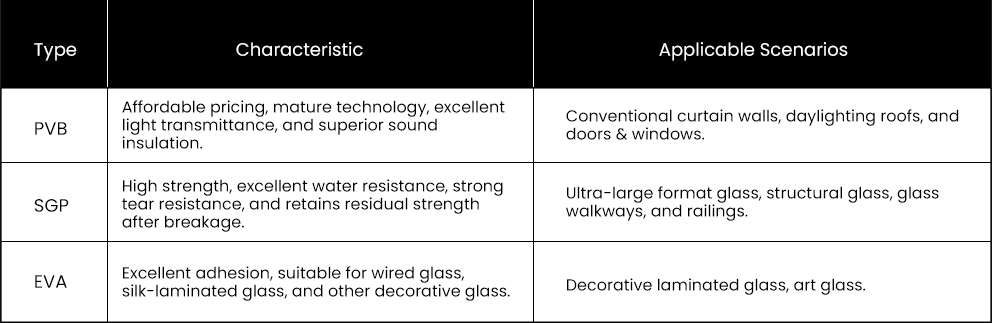
Laminated glass (also known as laminated safety glass) is a composite glass product made by sandwiching one or more layers of organic resin films (such as PVB, SGP, EVA, etc.) between two or more sheets of glass, then bonding them together under high temperature and high pressure.
The core lies in this interlayer film — it acts like a strong double-sided adhesive, but far more than that. Through the high-temperature and high-pressure process, it forms a solid composite. When the glass is impacted and breaks, the cracks are stopped at the interlayer. The enormous impact energy is absorbed by the elasticity of the film. Even if the glass cracks into a spiderweb pattern, the fragments remain firmly held by the tough membrane, preventing the glass from shattering or falling.
What Real Problems Can Laminated Glass Solve?
1. Primary Mission: Solving Safety Issues
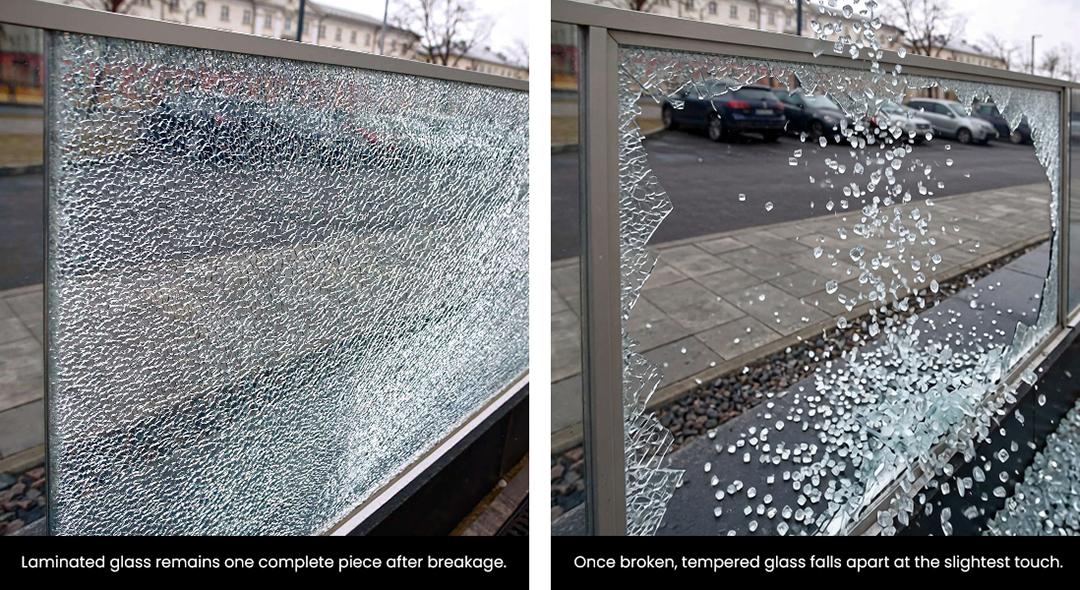
* Applications: Laminated glass is classified as safety glass. When subjected to external force and broken, the glass fragments do not scatter and the panel remains intact, preventing penetration. It is suitable for safety doors and windows, curtain walls, skylights, daylighting roofs, suspended ceilings, and other places with high safety requirements. It is also ideal for earthquake-prone, typhoon-prone, or hurricane-prone areas to reduce secondary damage from disasters.
* Advantages: It eliminates the risk of broken glass falling and injuring people. This is its core value. Especially for families with children or high-traffic public spaces, using laminated glass provides much greater peace of mind. While ordinary tempered glass breaks into small granules, it can still collapse as a whole.
2. Pain Point Solution: Blocking Noise, Especially Low-Frequency Noise
* Applications: Properties near streets, highways, or airports.
* Advantages: The interlayer film provides significantly better sound insulation against low-frequency noises such as bus and truck rumbling or air conditioning outdoor units compared to standard insulated glass. For those seeking a quiet environment, laminated insulated glass (laminated glass + insulated glass unit) is a common and effective solution.
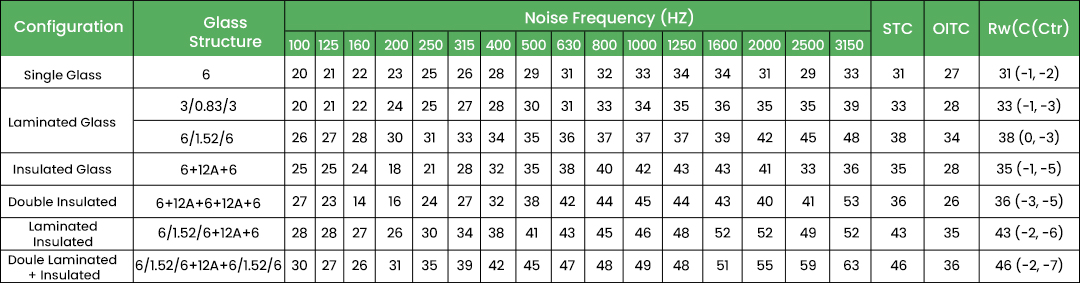
In addition, there are specialized “acoustic PVB films” designed for high sound insulation requirements. These can further improve the sound reduction index compared to ordinary PVB films.
This acoustic PVB film not only retains the basic properties of ordinary PVB — such as transparency, heat resistance, cold resistance, and mechanical strength — but is also optimized in structure or composition to enhance damping performance and sound wave absorption. As a result, it more effectively suppresses sound transmission when used in laminated glass, delivering superior overall acoustic performance.
Q: How to use laminated glass more effectively in insulated glass units?
In professional sound insulation designs, laminated glass is often combined with an insulated glass structure. The core principle is that the laminated interlayer effectively dampens and absorbs sound wave vibrations, especially excelling at blocking low-frequency noise.
Therefore, under the same glass thickness and air cavity depth, a composite structure with a laminated layer usually outperforms pure multi-layer insulated glass in overall sound insulation performance.

Sound insulation performance: Triple pane laminated > Triple pane insulated
However, note that the effect also depends on the type of noise. For high-frequency noises (such as sharp horns), the difference may not be significant. But for low-frequency noises (such as traffic rumble or AC outdoor units), laminated insulated glass tends to perform more reliably.
Important tip for cold northern regions: PVB film becomes harder and less elastic at low temperatures, which may reduce its sound insulation performance. It is recommended to position the laminated layer toward the indoor side during installation to avoid direct exposure to low temperatures, thereby maintaining long-term acoustic performance.
3. Added Value: Upgraded Security
*Security: Laminated glass is very difficult to break through quickly with conventional tools, making it suitable for applications requiring resistance to forced entry.
*High-level protection: By using special films or multi-layer combinations, various grades of bulletproof and blast-resistant glass can be produced for locations that need to withstand gunfire or explosions.


